AI embryo selection
Algorithms can help assess and rank embryos during IVF.
Keep in mindRanking an embryo does not change its DNA or guarantee a baby.
See the clinical evidence ↓A story about parenthood, technology, and faith.
A film exploring parenthood, technology, and faith. We offer reflection and conversation, not fertility treatment or medical advice.
Press Play to watch our intro. You can continue to the website anytime after starting.
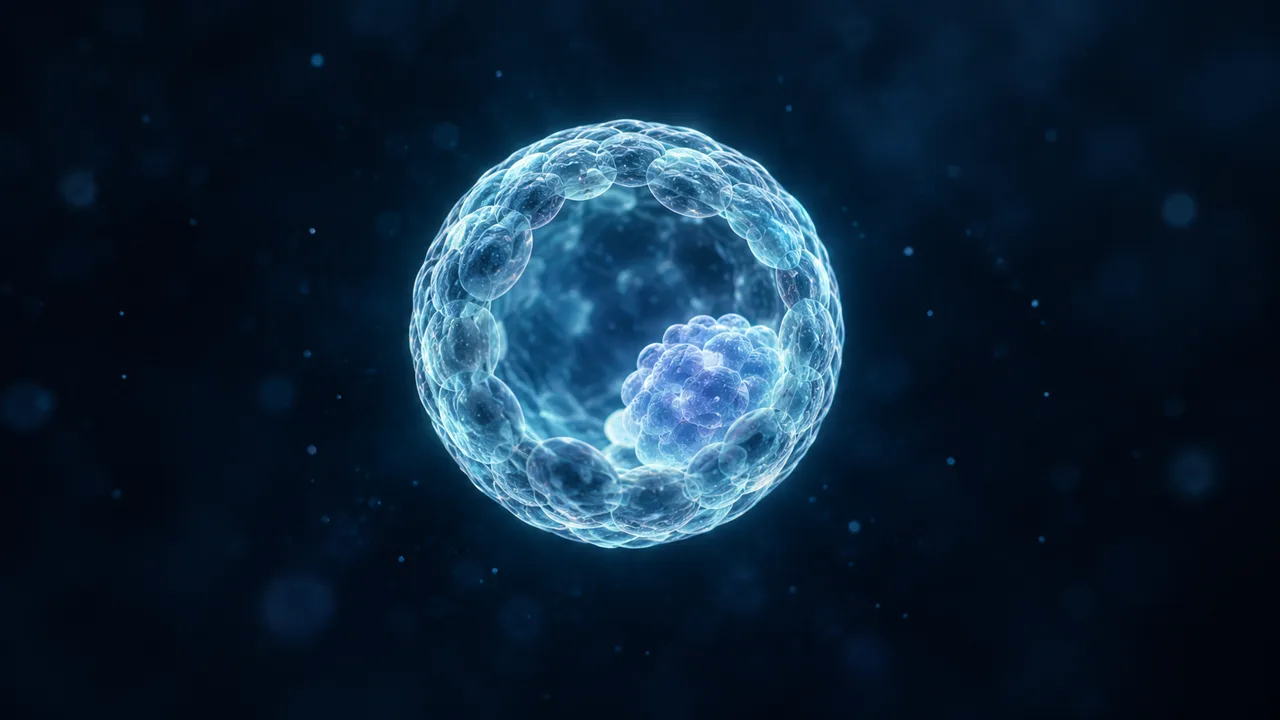
AI-generated conceptual illustration of a blue blastocyst, showing an outer cell layer and inner cell cluster; not clinical footage.
For a larger picture, tap Full screen and turn your phone sideways.
Press Play to watch our intro. You can continue to the website anytime after starting.
What does it really mean to “build a baby with AI”? Understand embryo selection, gene editing, and artificial-womb research—what each does, what the evidence shows, and what remains uncertain.
Plain-language explanations. Original sources. Clear limits.
IVF involves fertilization outside the body. The technologies below concern different parts of reproduction. A claim about one does not prove a claim about another.
Algorithms can help assess and rank embryos during IVF.
Keep in mindRanking an embryo does not change its DNA or guarantee a baby.
See the clinical evidence ↓Research explores support for development outside the body, including support for extremely premature infants.
Keep in mindPremature-infant support and a complete pregnancy outside the body are different claims.
See the research and limits ↓Gene editing changes DNA. Heritable changes could affect future generations.
Keep in mindEditing and selecting embryos are different interventions with different risks.
See the laboratory findings ↓How to read a claim: Ask which technology is involved, whether the evidence comes from people, animals, or a laboratory, and what outcome was actually measured. Sources and dates follow below.
Open a research summary to see the findings, limitations, and original sources. Clinical assessments, animal studies, and laboratory findings answer different questions.
Some time-lapse systems use algorithms to help embryologists assess embryos during IVF. This differs from editing an embryo’s DNA or developing a fetus outside the body.
What the regulator reports: The HFEA rates time-lapse imaging with automated analysis as having no effect on the chance of a baby for most fertility patients. Its page also reports no additional known risks from time-lapse imaging and incubation for patients or children born following treatment.
What this does not establish: That every AI tool is equivalent, that all fertility treatment is ineffective, or that AI-selected embryos have proven new health problems.
Read the HFEA assessment ↗A 2017 study supported premature lambs in an extra-uterine system for up to four weeks. This was animal research, not a human pregnancy from conception to birth.
What the FDA panel discussed: Its 2023 review addressed devices intended to support extremely premature infants, including organ development, nutrition, differences from natural amniotic fluid, device emergencies, and long-term assessment.
Unknowns: Those sources do not establish human long-term safety or prove that full pregnancy outside the body is clinically available. Current trial and approval status must be verified for each named device before making availability claims.
Read the original lamb study ↗Research in human embryos has shown that Cas9 editing can produce unintended chromosome loss. These are laboratory findings and cannot be converted into a percentage risk for future children without appropriate clinical evidence.
Why it matters: Heritable changes could affect descendants. WHO calls for strong oversight of human genome editing; potential medical benefits do not remove questions about safety, consent, and equity.
Keep the distinction: Embryo screening, AI-assisted ranking, and heritable gene editing are different interventions.
Read the human-embryo study (Cell, 2020) ↗CRISPR-Cas9 is often described as “genetic scissors”: it targets DNA and makes a cut so the sequence can be changed. That does not mean every edit works as intended.
December 30, 2019: He Jiankui was sentenced to three years in prison for illegal medical practice involving embryo gene editing for reproduction. The court’s account describes forged ethical-review documents and experiments conducted without establishing safety and effectiveness. This was a prosecution for those actions, not a ban on all gene-editing research.
Court-hosted account, published December 31, 2019 ↗
2020: Emmanuelle Charpentier and Jennifer Doudna received the Nobel Prize in Chemistry for developing a method for genome editing. They were different researchers, and the prize recognized the editing method—not He Jiankui’s reproductive experiments.
Nobel Prize’s official award record, 2020 ↗
The distinction: Developing a powerful scientific tool, treating a person’s non-reproductive cells, and editing embryos for reproduction raise different scientific, safety, and consent questions. A Nobel Prize does not establish that every application is safe or authorized.
Optional: read the full research guide ↗
Initial source review: October 17, 2026 (Pacific). Source dates are identified above. Educational summaries; individual medical decisions belong with a qualified clinician.
New to the subject? Start with the first question, or search for what is on your mind. Every answer opens here on this page.
6 questions. Open one to read the answer right here.
The phrase can refer to different steps in reproduction. In vitro fertilization (IVF) involves fertilization outside the body. Algorithms can help assess embryos; gene editing changes DNA; artificial-womb research explores support for development. These are different interventions, with different evidence and risks. A headline alone does not tell you which is involved.
Source: HFEA — embryo assessment in IVF ↗. See the questions below for the separate research areas.
Some systems analyze time-lapse images of developing embryos and use algorithms to score or rank them. An embryologist can use that information in selecting an embryo. Ranking embryos is a selection task; it does not itself change their DNA.
For most fertility patients, the HFEA finds that automated analysis in time-lapse incubation has no demonstrated effect on the chance of having a baby. That assessment concerns this particular add-on; it is not a verdict on every use of AI in fertility care.
Source: HFEA — evidence and ratings ↗.
Supporting an extremely premature infant and supporting a pregnancy from conception to birth are different claims. The FDA's September 2023 advisory discussion concerned devices for extremely premature infants and evidence needed for first-in-human studies. That discussion does not establish an available conception-to-birth service. Check the named device and its current regulatory records before relying on a claim.
No. Selecting among embryos and changing DNA are different interventions. “Designer baby” is an imprecise label. WHO's 2021 recommendations address oversight, safety, effectiveness, and ethics in human genome editing, including changes that could be inherited by future generations. A claim about embryo ranking does not establish that DNA was edited.
Look for a named institution, researchers, device, and original publication. Check whether the images show an illustration, animation, animal study, or documented human treatment. Read the study date, participants, comparison group, and measured outcome. A promotional video or generated image does not establish safety, effectiveness, or regulatory approval.
Our blue embryo image is an AI-generated conceptual illustration, not clinical footage. This checklist helps you examine a claim; it does not mean we have authenticated a particular video.
No matching answer yet. Try “embryo,” “womb,” “gene editing,” or “evidence.”
These answers are researched editorial summaries. They are not personalized medical advice. Source review: October 19, 2026. Original publication dates are shown where relevant. All answers can be read here; original-source links are optional.
Ask about embryo selection, artificial wombs, gene editing, or the evidence behind a headline.
Live AI conversation is not available yet. You can explore the researched answers above.
Follow early results, safety concerns, and limits. New papers are automatically checked against a selected journal list. Source identity is checked; study conclusions still need critical review.
The server checks PubMed at startup and every six hours while running. This feed covers selected journals and topics, not every study. Titles, dates, and publication types come from source records. Indexing is not proof of quality, approval, or clinical availability. Papers are not selected by whether their findings are positive or negative.
Our new review examines 2026 professional guidance alongside earlier randomized evidence, separating laboratory efficiency from pregnancy outcomes.
Read the evidence and limitations ↗Editorial review, distinct from the automatic paper-discovery feed below.
Checking the research feed… Reviewed findings remain available below.
Automatic records are discovery links, not independently reviewed summaries. Retractions and editorial-only items are filtered when identified in the source record; indexing and correction notices can be delayed.
A 2025 report described a personalized base-editing treatment for one infant with CPS1 deficiency. This was treatment of non-reproductive cells after birth—not editing an embryo or creating a “designer baby.” Early findings from one patient do not establish long-term safety or effectiveness for everyone.
Original report published online May 15, 2025. Reviewed October 19, 2026.
Read the original NEJM report ↗A 2020 laboratory study found that Cas9 cleavage in human embryos could cause loss of chromosomes or chromosome segments. It identifies an important hazard; it does not provide a clinical risk percentage for children born after editing.
Published online October 29, 2020; Cell issue December 10, 2020. Reviewed October 19, 2026.
Read the original Cell study ↗Build AI Baby brings a Christian perspective to family and technology. These reflections are separate from the scientific evidence above. Choose what is helpful to you.
Sarah and Elizabeth knew years of longing. Their stories remind us that what seems impossible to us is not beyond God.
We believe God still works miracles today. We would be honored to pray with you and walk beside you as you seek Him.
These stories are an invitation to faith, not a promise of pregnancy. Your fertility does not measure your faith or your worth.
Let us pray with you ↗God fulfilled His promise, and Sarah gave birth to Isaac in her old age.
GENESIS 21:1–7 ↗Elizabeth and Zechariah’s long wait became part of the story of John the Baptist.
LUKE 1:5–25 ↗Bring your questions, disappointment, and hope. Prayer is offered freely, without pressure.
What would it mean to make room for a child in your life?
A career, personal hopes, and a family can all matter deeply. Parenthood invites thoughtful conversations about time, support, responsibilities, and a child’s wellbeing.
Technology can change what is medically possible. It cannot make the lifelong commitment to love, protect, and care for a child on our behalf.
Have an honest conversation ↗Adoption centers the needs of a child and creates a lifelong family commitment. It deserves thoughtful preparation, qualified guidance, and respect for every part of a child’s story.
James 1:27 calls believers to care for orphans and widows. We offer prayer and conversation; we are not an adoption agency.
Talk with us about your next step ↗You may be carrying the ache of infertility, or wondering how a child could fit into your life. Begin with the question closest to your heart.
Waiting can feel lonely. Your grief is real, and you do not have to carry it alone. Find biblical hope and an invitation to prayer.
Hope through infertility ↗Career, independence, recognition, and the life we have built can make parenthood feel costly. What does it mean to make room for another life?
Reflect on love and sacrifice ↗“You knit me
together in my
mother’s womb.”Psalm 139:13 · NIV excerpt
You do not need to have the right words or all the answers. Share only what you feel comfortable sharing.
Share your story, ask a question, or let us pray with you through grief, loss, uncertainty or any season of life. Every conversation is freely offered as our service to God Almighty. There is never a charge. Please do not include medical records or other highly sensitive information.
The contact form is not accepting messages yet. You can explore the stories, Scripture, and research while we prepare a private way to hear from you.
Watch our introduction, then explore the research and reflections. The blue embryo image is a conceptual AI illustration, not clinical footage.